Skip Content
You are currently on the new version of our website. Access the old version .

Journal of Composites Science

Journal of Composites Science is an international, peer-reviewed, open access journal on the science and technology of composites, published monthly online by MDPI.

Quartile Ranking JCR - Q2 (Materials Science, Composites)

All Articles (2,979)

This work investigates the effect of recycling on the rheological and thermal properties of petroleum-based polyester nanocomposites. PET and PBT are used widely in the automobile and packaging industries, and there is a growing need for effective ways to utilize recycled polyesters. The melt mixing method was used to prepare the nanocomposites using a twin-screw extruder. After recycling, the rheological properties of the PBT nanocomposite remained stable, as the degradation of PBT chain was low due to the presence of MWCNT and molecular chain flexibility. In contrast, the complex viscosity of PET recycled nanocomposite decreases significantly because the high processing temperature of 280 °C led to substantial polymer chain scission and network breakdown. Due to the presence of MWCNT, PET and PBT nanocomposites show higher thermal stability than pure and recycled nanocomposites. The recycling of PET and PBT nanocomposites demonstrated potent thermal stability under inert and air/oxidative atmospheres. These results indicate that the effect of recycling strongly depends on the polymer matrix: while PET-based nanocomposites exhibit notable reductions in rheological properties after recycling, PBT-based nanocomposites retain stable rheological and thermal performance due to MWCNT reinforcement. The enhancement in this research could make the recycled materials valuable for the automotive industry.

7 February 2026
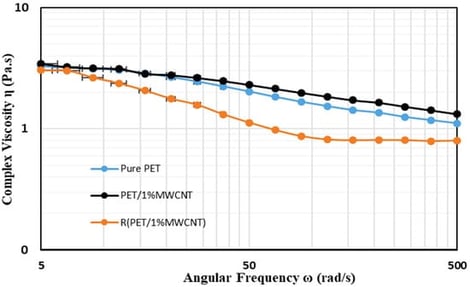
Complex viscosity of pure PET and its nanocomposites.

This paper presents a novel carbon fiber reinforced polymer (CFRP) crash box design, incorporating numerical analysis and manufacturing aspects. Within the design and analysis phases, a novel numerical methodology is employed to mitigate computational costs in estimating specific energy absorption (SEA). The proposed approach involves a reduction in ply interfaces and modification of pertinent material properties to optimize energy dissipation, achieving more than 50% reduction in simulation time. This methodology is applied to the design of a composite crash box made of unidirectional (UD) carbon/epoxy prepregs, resulting in a new geometry: sun-like shape featuring four sinusoidal arms connected to a central circular core. Subsequent manufacturing and testing reveal a SEA value of 79.46 J/g for designed geometry, surpassing metallic counterparts by a factor of 3 to 4. Furthermore, this study conducts a comparative analysis of energy absorption performance between unidirectional and woven fabric prepregs for the same geometry. Utilizing carbon/epoxy woven fabric (WF) prepregs further enhances the SEA to 89.26 J/g. Finally, the application of edge tapering to the crash box structure is shown to eliminate initial peak loads, thereby preventing excessive deceleration.

6 February 2026

The comparison of SEA performances of several CFRP geometries [14].

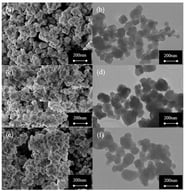
Carbon dioxide (CO2) and methane (CH4) are major greenhouse gases, and their increasing emissions contribute significantly to global warming. Dry reforming of methane (DRM) offers a promising route to mitigate these emissions by simultaneously utilizing both CO2 and CH4 and converting them into syngas, a valuable intermediate for producing fuels and chemicals. Nickel-based catalysts are widely used in DRM due to their high activity and cost-effectiveness. However, their performance depends strongly on metal loading and support properties. This study aims to investigate the effect of different NiO loadings (40, 50, and 60 wt%) on the structural and morphological characteristics of NiO-YSZ and NiO-SDC catalysts synthesized via the impregnation method. In this method, yttria-stabilized zirconia (YSZ) and samarium-doped ceria (SDC) powders were dispersed into a nickel precursor solution to form supported catalysts, which were then characterized to evaluate their structural integrity, crystallinity, and surface morphology. The results showed that higher NiO loadings generally improved the structural and morphological features, with NiO-SDC demonstrating better characteristics than NiO-YSZ. These findings provide essential insights that will guide future work on fabricating membranes using these catalysts for the CO2-CH4 dry reforming process.

6 February 2026

FESEM and TEM images of (a,b) 40NiO-YSZ, (c,d) 50NiO-YSZ, and (e,f) 60NiO-YSZ.

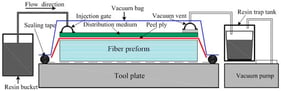
Vacuum infusion experiments were conducted to characterize the elastic recovery and thickness effect in the vacuum infusion molding process (VIMP). The results indicate that both the local fluid pressure and the part thickness increment increase with flow propagation until filling completion, and subsequently decrease during the post-filling stage. The maximum thickness increment increases with the number of reinforcement layers, while the thickness-increment rate decreases due to the enhanced compliance of the reinforcement. Specifically, for reinforcements with 10, 20, and 30 layers under in-plane 1D (One-Dimensional) flow, the thickness-increment rates are 4.97%, 4.74%, and 3.86%, respectively. In out-plane 1D flow, a distinct progressive three-stage thickness growth is observed, with corresponding increment rates of 43.7%, 23.0%, and 15.8% for 10, 20, and 30 layers, highlighting a significantly more pronounced effect. In contrast, for both coupled seepage-flow configurations (A and B), the thickness-increment rate shows no significant variation with layer number and remains consistently around 6%. This suggests that the thickness effect is offset by the coupled seepage-flow interaction of in-plane, out-plane, and distribution medium (DM) flows. It can be concluded that elastic recovery decreases with increasing part thickness. The thickness effect exerts a positive influence on the vacuum infusion molding of large-scale (thick-section) composite structures. Both elastic recovery and thickness effect are closely related to the injection mode (process strategy), with the effect in out-plane 1D flow being significantly greater than that in in-plane flow and coupled seepage flow.

5 February 2026

The setup schematic of VIMP.

News & Conferences

Issues

Open for Submission

Editor's Choice

Get Alerted

Add your email address to receive forthcoming issues of this journal.

XFacebookLinkedIn
J. Compos. Sci. - ISSN 2504-477X